 ASKA – AUTOMATIC IDENTIFICATION SYSTEMS
Labels / GS1 code

A standard GS1 logistics label, also known as a GS1 transport label, provides clear, accurate information exchange.
GS1 logistics labels allow each shipping unit to be identified throughout the supply chain.
A logistics label usually presents information about its shipping unit in both human-readable and barcode formats.
GS1 logistics label applications:
GS1-128 barcodes are used on logistics labels. The standard specifies both barcode symbology and data format, providing security and high information density.
GS1-128 encodes numeric and alphanumeric data. Each data element is preceded by an application identifier, a two-, three- or four-digit prefix defining its meaning.
Each shipping unit must have a unique SSCC, or Serial Shipping Container Code. Other fields are optional and are included as required.
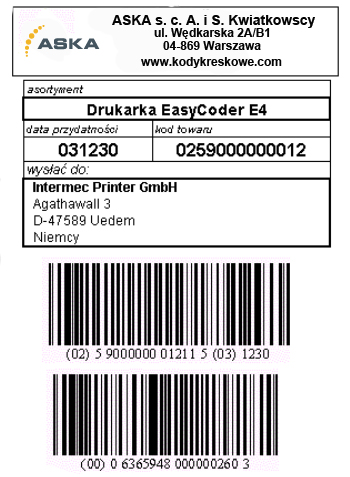 The printer required depends on the label dimensions. Two sizes are commonly used:
- 104 × 150 labels (width × height). This popular size can be printed on most four-inch label printers.
- A5 labels (150 × 210 mm)
These require a less common six-inch printer, increasing both equipment and running costs because of the larger label. A5 labels support large barcodes that can be read from greater distances.
System components are selected according to requirements. Key factors include temperature, humidity, dust and the volume of operations, such as label printing and barcode scanning.
